> ## Documentation Index
> Fetch the complete documentation index at: https://docs.cleopetra.fun/llms.txt
> Use this file to discover all available pages before exploring further.
# How it works
> Pricing, NAV, and the mechanics of a Thesis Index
## Index architecture
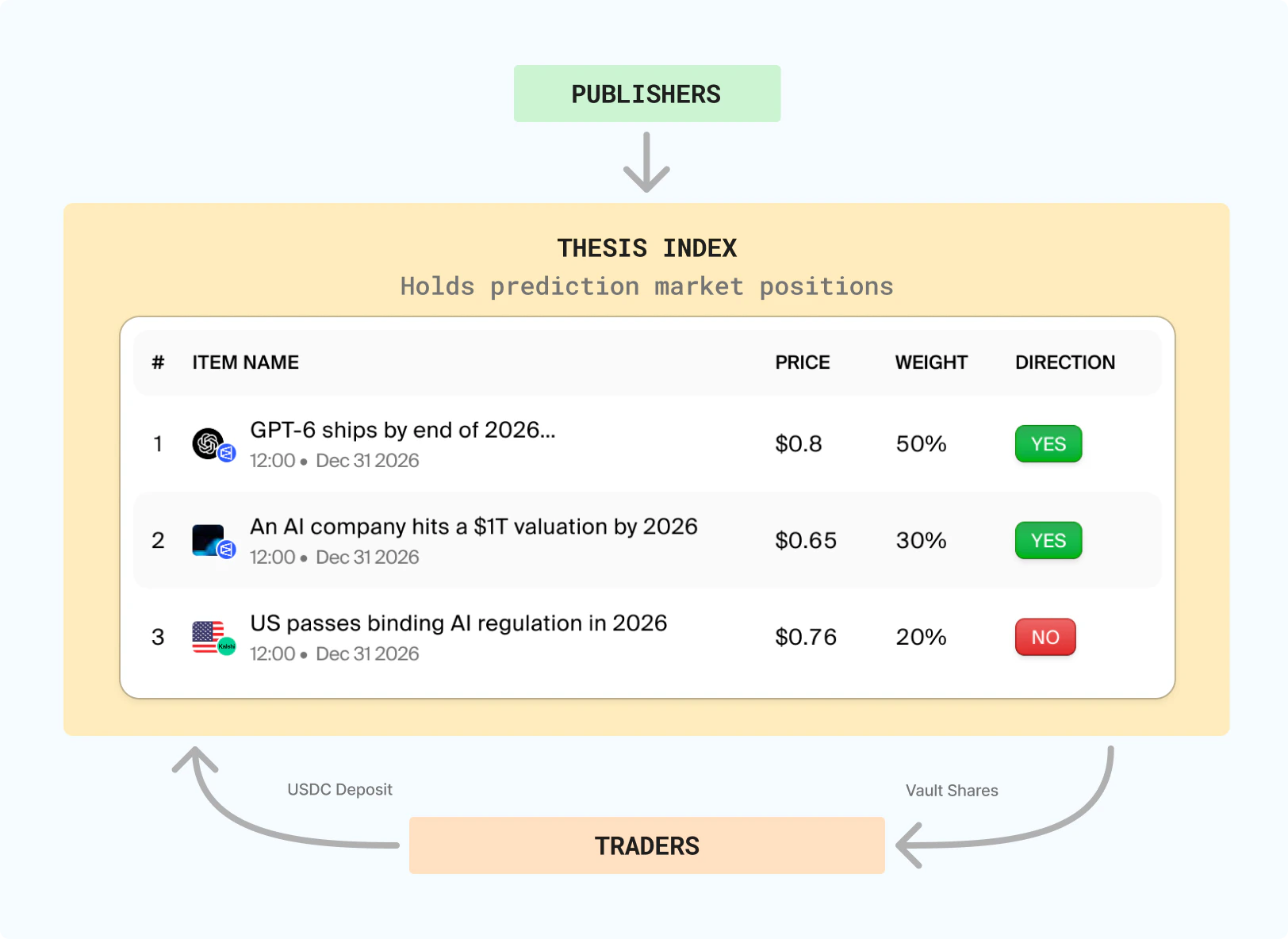
A Thesis Index is an on-chain vault that holds prediction market positions and issues shares to depositors.
* The publisher defines the composition (markets, directions, weights).
* Traders deposit stablecoin and receive shares.
* The index holds the underlying positions.
* Shares represent a proportional claim on whatever market value the index holds at any moment.
 In v1, Indices are vault-based. Tokenisation of shares is on the roadmap.
## Index NAV
The NAV (Net Asset Value) of a Thesis Index is the total market value of every position it holds, marked to current prices, plus any idle stablecoin in reserve.
$$
\text{NAV} = \left( \sum_{i=1}^{n} \text{Balance}_i \times \text{Price}_i \right) + \text{Stablecoin reserve}
$$
Where:
* **balance** is the number of contracts held in position *i*
* **price** is the current market price of that contract
* **n** is the number of positions in the index
* **Stablecoin reserve** is any stablecoin (USDC/USDT/USDG) held, typically from a resolved market that paid out, or held between a rebalance
## Index price
The price of one share is NAV divided by total shares outstanding.
$$
\text{Index price} = \frac{\text{NAV}}{\text{Total shares}}
$$
At creation, index price is set to **\$1.00**. The first depositor receives shares 1:1 with USDC. After that, as NAV moves, new depositors receive shares at the current index price:
$$
\text{Shares minted} = \frac{\text{USDC deposited}}{\text{Index price}}
$$
Shares are not the same as prediction market contracts. Shares are a claim on the entire index. The index separately holds the underlying contracts on the trader's behalf.
## Index lifecycle
A full lifecycle, from creation to final resolution.
### 1. Index creation
A publisher creates an index with three positions:
| Market | Direction | Weight | Current price |
| -------- | --------- | ------ | ------------- |
| Market A | YES | 40% | \$0.70 |
| Market B | YES | 40% | \$0.80 |
| Market C | YES | 20% | \$0.40 |
The publisher seeds the index with **\$100**. Each position is sized proportional to its weight at the current price:
* Market A: $(100 \times 0.40) / 0.70 = $ **57.14 contracts**
* Market B: $(100 \times 0.40) / 0.80 = $ **50 contracts**
* Market C: $(100 \times 0.20) / 0.40 = $ **50 contracts**
Checking NAV: $57.14 \times 0.70 + 50 \times 0.80 + 50 \times 0.40 = $100.
* Total NAV: **\$100**
* Shares issued: **100**
* **Index price: \$1.00**
### 2. Prices move
A week later, Market A rallies from \$0.70 to \$0.85. The other two are unchanged.
$$
\text{NAV} = (57.14 \times 0.85) + (50 \times 0.80) + (50 \times 0.40) = \$108.57
$$
$$
\text{Index price} = \frac{108.57}{100} = \$1.086
$$
The index is up **8.6%**, driven by Market A. No market has resolved yet, just mark-to-market movement.
### 3. New trader deposits
A second trader deposits **\$35** at the current index price of \$1.086.
$$
\text{Shares minted} = \frac{35}{1.086} = 32.23
$$
Total shares: $100 + 32.23 = $ **132.23**.
The \$35 is deployed at *current* prices (A is now \$0.85, not \$0.70):
* Market A: $57.14 + (35 \times 0.40)/0.85 = $ **73.61 contracts**
* Market B: $50 + (35 \times 0.40)/0.80 = $ **67.5 contracts**
* Market C: $50 + (35 \times 0.20)/0.40 = $ **67.5 contracts**
Index price stays at **\$1.086**. The new trader buys in at the current price; existing holders aren't diluted.
### 4. Markets A and B resolve YES
Resolution dates arrive. Markets A and B resolve in the publisher's favor. Each YES contract redeems for \$1.00.
* A: \$73.61 × \$1.00 = \$73.61 → USDC reserve
* B: \$67.5 × \$1.00 = \$67.50 → USDC reserve
Total USDC reserve: **\$141.11**. Market C is still active at \$0.40.
$$
\text{NAV} = 0 + 0 + (67.5 \times 0.40) + 141.11 = \$168.11
$$
$$
\text{Index price} = \frac{168.11}{132.23} = \$1.271
$$
The index is up **27.1%** from launch.
### 5. Market C resolves NO
Market C resolves against the thesis. Each YES contract redeems for \$0.
$$
\text{NAV} = 0 + 0 + (67.5 \times 0) + 141.11 = \$141.11
$$
$$
\text{Index price} = \frac{141.11}{132.23} = \$1.067
$$
The index closes at **\$1.067 per share: up 6.7%** from launch.
Two of three markets resolved YES and they were the heavier-weighted ones. The index ended up despite Market C resolving against the thesis. Sizing matters as much as direction.
### 6. Withdrawals
Both participants withdraw their full position at the final index price of \$1.067.
| Participant | Shares | Withdrawn | Deposited | PnL |
| ---------------- | ------ | --------- | --------- | --------------- |
| Publisher | 100 | \$106.70 | \$100.00 | +\$6.70 (+6.7%) |
| Second depositor | 32.23 | \$34.39 | \$35.00 | -\$0.61 (-1.7%) |
The publisher is up because they were in from the start. The second depositor is slightly down as they bought in at \$1.086 after Market A had already rallied, and the final index price of \$1.067 settled below their entry.
***
An index's price appreciates as its underlying markets move in the thesis' favor, depreciates when they resolve against it, and compounds across both.
Publishers can rebalance the index at any point to add and remove markets or redeploy USDC reserves. Rebalancing changes composition, not the index price.
In v1, Indices are vault-based. Tokenisation of shares is on the roadmap.
## Index NAV
The NAV (Net Asset Value) of a Thesis Index is the total market value of every position it holds, marked to current prices, plus any idle stablecoin in reserve.
$$
\text{NAV} = \left( \sum_{i=1}^{n} \text{Balance}_i \times \text{Price}_i \right) + \text{Stablecoin reserve}
$$
Where:
* **balance** is the number of contracts held in position *i*
* **price** is the current market price of that contract
* **n** is the number of positions in the index
* **Stablecoin reserve** is any stablecoin (USDC/USDT/USDG) held, typically from a resolved market that paid out, or held between a rebalance
## Index price
The price of one share is NAV divided by total shares outstanding.
$$
\text{Index price} = \frac{\text{NAV}}{\text{Total shares}}
$$
At creation, index price is set to **\$1.00**. The first depositor receives shares 1:1 with USDC. After that, as NAV moves, new depositors receive shares at the current index price:
$$
\text{Shares minted} = \frac{\text{USDC deposited}}{\text{Index price}}
$$
Shares are not the same as prediction market contracts. Shares are a claim on the entire index. The index separately holds the underlying contracts on the trader's behalf.
## Index lifecycle
A full lifecycle, from creation to final resolution.
### 1. Index creation
A publisher creates an index with three positions:
| Market | Direction | Weight | Current price |
| -------- | --------- | ------ | ------------- |
| Market A | YES | 40% | \$0.70 |
| Market B | YES | 40% | \$0.80 |
| Market C | YES | 20% | \$0.40 |
The publisher seeds the index with **\$100**. Each position is sized proportional to its weight at the current price:
* Market A: $(100 \times 0.40) / 0.70 = $ **57.14 contracts**
* Market B: $(100 \times 0.40) / 0.80 = $ **50 contracts**
* Market C: $(100 \times 0.20) / 0.40 = $ **50 contracts**
Checking NAV: $57.14 \times 0.70 + 50 \times 0.80 + 50 \times 0.40 = $100.
* Total NAV: **\$100**
* Shares issued: **100**
* **Index price: \$1.00**
### 2. Prices move
A week later, Market A rallies from \$0.70 to \$0.85. The other two are unchanged.
$$
\text{NAV} = (57.14 \times 0.85) + (50 \times 0.80) + (50 \times 0.40) = \$108.57
$$
$$
\text{Index price} = \frac{108.57}{100} = \$1.086
$$
The index is up **8.6%**, driven by Market A. No market has resolved yet, just mark-to-market movement.
### 3. New trader deposits
A second trader deposits **\$35** at the current index price of \$1.086.
$$
\text{Shares minted} = \frac{35}{1.086} = 32.23
$$
Total shares: $100 + 32.23 = $ **132.23**.
The \$35 is deployed at *current* prices (A is now \$0.85, not \$0.70):
* Market A: $57.14 + (35 \times 0.40)/0.85 = $ **73.61 contracts**
* Market B: $50 + (35 \times 0.40)/0.80 = $ **67.5 contracts**
* Market C: $50 + (35 \times 0.20)/0.40 = $ **67.5 contracts**
Index price stays at **\$1.086**. The new trader buys in at the current price; existing holders aren't diluted.
### 4. Markets A and B resolve YES
Resolution dates arrive. Markets A and B resolve in the publisher's favor. Each YES contract redeems for \$1.00.
* A: \$73.61 × \$1.00 = \$73.61 → USDC reserve
* B: \$67.5 × \$1.00 = \$67.50 → USDC reserve
Total USDC reserve: **\$141.11**. Market C is still active at \$0.40.
$$
\text{NAV} = 0 + 0 + (67.5 \times 0.40) + 141.11 = \$168.11
$$
$$
\text{Index price} = \frac{168.11}{132.23} = \$1.271
$$
The index is up **27.1%** from launch.
### 5. Market C resolves NO
Market C resolves against the thesis. Each YES contract redeems for \$0.
$$
\text{NAV} = 0 + 0 + (67.5 \times 0) + 141.11 = \$141.11
$$
$$
\text{Index price} = \frac{141.11}{132.23} = \$1.067
$$
The index closes at **\$1.067 per share: up 6.7%** from launch.
Two of three markets resolved YES and they were the heavier-weighted ones. The index ended up despite Market C resolving against the thesis. Sizing matters as much as direction.
### 6. Withdrawals
Both participants withdraw their full position at the final index price of \$1.067.
| Participant | Shares | Withdrawn | Deposited | PnL |
| ---------------- | ------ | --------- | --------- | --------------- |
| Publisher | 100 | \$106.70 | \$100.00 | +\$6.70 (+6.7%) |
| Second depositor | 32.23 | \$34.39 | \$35.00 | -\$0.61 (-1.7%) |
The publisher is up because they were in from the start. The second depositor is slightly down as they bought in at \$1.086 after Market A had already rallied, and the final index price of \$1.067 settled below their entry.
***
An index's price appreciates as its underlying markets move in the thesis' favor, depreciates when they resolve against it, and compounds across both.
Publishers can rebalance the index at any point to add and remove markets or redeploy USDC reserves. Rebalancing changes composition, not the index price.